
Hair transplantation is designed to restore hair density, improve the hairline, and treat areas affected by thinning or hair loss.
Treatment planning depends on the pattern of hair loss, donor availability, graft numbers, and the kind of result that can be achieved naturally and safely.
Starting from 80 THB per graft (~ 2.4 USD)

Hair transplantation is a procedure designed to move healthy hair follicles from a donor area to areas affected by thinning or hair loss.
It may be used to improve the hairline, temples, crown, or other areas of reduced density, depending on the pattern of hair loss and donor supply.
The right plan depends on hair characteristics, donor availability, graft numbers, hairline design, and long-term planning.
Patients concerned about frontal hairline recession or facial framing.
Patients with temple thinning or a more receded hairline shape.
Patients with thinning rather than complete loss in selected areas.
Patients who want a clearer understanding of expected graft range and treatment scale.
Hair transplantation usually involves three stages:
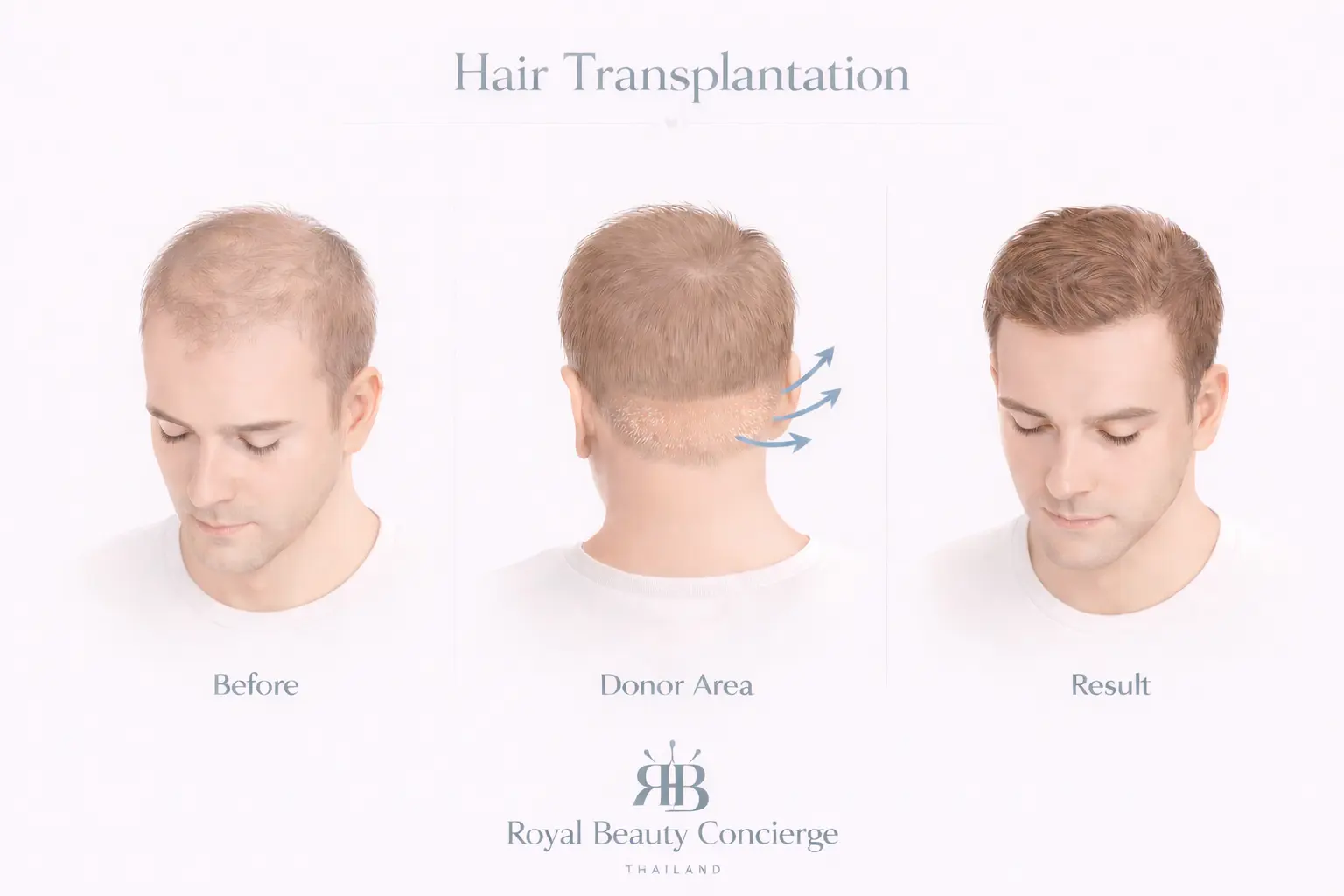
Donor harvesting from an area with enough healthy follicles
Graft preparation so follicles can be placed carefully
Recipient placement into the target area to improve density and shape
The goal is not only to add hair. The goal is to create a natural-looking result that suits the face, hair pattern, and long-term hair loss plan.

Your case is reviewed with planning based on your pattern of hair loss, donor supply, graft numbers, treatment goals, and medical suitability.

Hair transplantation is performed in a licensed medical setting in Bangkok, Thailand, with appropriate monitoring and follow-up built into the process.
Tenderness, redness, and small scabs in treated areas are common.
Early healing is reviewed, and the scalp often begins to look more settled.
Most of the early visible healing improves, although the final result is still far away.
New growth develops gradually over time. Hair transplant results are not immediate and continue to mature in stages.
The goal is to plan carefully, use grafts responsibly, and support healing safely.
This depends on the treatment area, the level of hair loss, donor availability, and the density plan. Final graft numbers are confirmed after review.
Most international patients should plan around 4–7 days in Thailand, depending on the procedure and follow-up plan.
Early healing happens first, but visible new growth usually develops gradually over several months. Final maturation takes longer.
The goal is to create a natural-looking result through careful hairline design, appropriate graft placement, and realistic density planning.